MindMover
MindMover's JournalAnd we are all alone in the universe ...LMAO
http://www.vox.com/2015/1/26/7915359/andromeda-galaxy-video
Is America Crazy ?
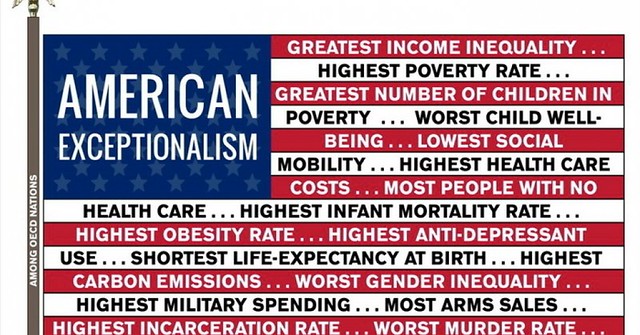
Americans who live abroad -- more than six million of us worldwide (not counting those who work for the U.S. government) -- often face hard questions about our country from people we live among. Europeans, Asians, and Africans ask us to explain everything that baffles them about the increasingly odd and troubling conduct of the United States. Polite people, normally reluctant to risk offending a guest, complain that America’s trigger-happiness, cutthroat free-marketeering, and “exceptionality” have gone on for too long to be considered just an adolescent phase. Which means that we Americans abroad are regularly asked to account for the behavior of our rebranded “homeland,” now conspicuously in decline and increasingly out of step with the rest of the world.
In my long nomadic life, I’ve had the good fortune to live, work, or travel in all but a handful of countries on this planet. I’ve been to both poles and a great many places in between, and nosy as I am, I’ve talked with people all along the way. I still remember a time when to be an American was to be envied. The country where I grew up after World War II seemed to be respected and admired around the world for way too many reasons to go into here.
That’s changed, of course. Even after the invasion of Iraq in 2003, I still met people -- in the Middle East, no less -- willing to withhold judgment on the U.S. Many thought that the Supreme Court’s installation of George W. Bush as president was a blunder American voters would correct in the election of 2004. His return to office truly spelled the end of America as the world had known it. Bush had started a war, opposed by the entire world, because he wanted to and he could. A majority of Americans supported him. And that was when all the uncomfortable questions really began.
http://www.commondreams.org/views/2015/01/11/country-crazy-inquiring-minds-elsewhere-want-know
Satire is not always supposed to be funny ...hahahaha
sat·ire
ˈsaˌtī ə
ə r/
r/
noun
the use of humor, irony, exaggeration, or ridicule to expose and criticize people's stupidity or vices, particularly in the context of contemporary politics and other topical issues.
synonyms: mockery, ridicule, derision, scorn, caricature; More
a play, novel, film, or other work that uses satire.
plural noun: satires
"a stinging satire on American politics"
synonyms: parody, burlesque, caricature, lampoon, skit; More
a genre of literature characterized by the use of satire.
FURTHERMORE as journalists we are not supposed to be sensitive to others sensibilities when this BIZZARRO WORLD is burning in its stupid idiosyncrasies ... We are supposed to be screaming the idiotic nature of humankind until it finally echoes in the chambers of the consciousness of man ...
YOU are totally wrong, Nicholas "Bill" Kristof for stating otherwise today ...
Attack Charlie Hebdo: what do we know of two suspects?
Two of the three suspects in the massacre that decimated the writing of Charlie Hebdo , Wednesday, January 7, were still at large in the Wednesday and Thursday night. The Police launched a national search warrant against Sharif and Said Kouachi two brothers aged 32 and 34 years. They are "considered dangerous and heavily armed ed " by investigators.
Shortly before the unveiling of their portraits in a call to witnesses issued by the police headquarters in Paris , a third suspect, aged 18, presented himself voluntarily to the police station of Charleville-Mezieres in the Ardennes. A police source, contacted by Le Monde said that "no charge" had been made against him and that "in his case, it's just simple checks. »
En savoir plus sur http://www.lemonde.fr/attaque-contre-charlie-hebdo/article/2015/01/08/attaque-a-charlie-hebdo-que-sait-on-des-deux-suspects-recherches_4551181_4550668.html#iXC7sOpxiJfqKeIk.99
NBC Walks Back Report of Dead Suspect, ABC Reports One Suspect in Custody
Source: Slate
an. 7, 2015, 8:45 p.m.: ABC News, France 24, and the AFP are reporting that the youngest of the three suspects in Wednesday’s attack has surrendered to police.
NBC’s Pete Williams, meanwhile, appeared to walk back an earlier report that one suspect had been killed and the other two had been detained. “To be fair here we just don’t know exactly what the situation is in France,” he said on MSNBC.
Earlier, Williams had reported that two senior U.S. counterterrorism had told NBC that the three men were no longer at large.
Read more: http://www.slate.com/blogs/the_slatest/2015/01/07/paris_terror_attack_terrorists_attack_charlie_hebdo_killing_at_least_12.html
http://www.haaretz.com/news/world/1.635931

OPEC Presents: QE4 and Deflation
Thinking plummeting oil prices are good for the economy is a mistake. They instead, as I said only yesterday in The Price Of Oil Exposes The True State Of The Economy, point out how bad the global economy is doing. QE has been able to inflate stock prices way beyond anything remotely looking fundamental, but energy prices have now deflated instead of stocks. Something had to give at some point. Turns out, central banks weren’t able to inflate oil prices on top of everything else. Stocks and bonds are much easier to artificially inflate than commodities are.
The Fed and ECB and BOJ and PBoC may of course yet try to invest in oil, they’re easily crazy enough to try, but it will be too late even if they did. In that sense, one might argue that OPEC – or rather Saudi Arabia – has gifted us QE4, but the blessings of the ‘low oil price stimulus’ will of necessity be both mixed and short-lived. Because while the lower prices may free some money for consumers, not nearly all of the freed up ‘spending space’ will end up actually being spent. So in the end that’s a net loss as far as spending goes.
The ‘OPEC Q4? may also keep some companies from going belly up for a while longer due to falling energy costs, but the flipside is many other companies will go bust because of the lower prices, first among them energy industry firms. Moreover, as we’re already seeing, those firms’ market values are certain to plummet. And, see yesterday’s essay linked above, many of eth really large investors, banks, equity funds et al are heavily invested in oil and gas and all that comes with it. And they are about to take some major hits as well. OPEC may have gifted us QE4, but it gave us another present at the same time: deflation in overdrive.
You can’t force people to spend, not if you’re a government, not if you’re a central bank. And if you try regardless, chances are you wind up scaring people into even less spending. That’s the perfect picture of Japan right there. There’s no such thing as central bank omnipotence, and this is where that shows maybe more than anywhere else. And if you can’t force people to spend, you can’t create growth either, so that myth is thrown out with the same bathwater in one fell swoop.
http://www.theautomaticearth.com/opec-presents-q4-and-deflation/
U.S. auction of Silk Road bitcoins draws 27 bids
(Reuters) - The U.S. Marshals Service on Thursday received more than two dozen bids for 50,000 bitcoins seized from the alleged owner of Silk Road, an Internet black-market bazaar on which authorities say drugs and other illegal goods could be bought.
Lynzey Donahue, a Marshals Service spokeswoman, said the government had 11 registered bidders and 27 resulting bids. Winning bidders for the bitcoins, valued at $18.6 million, will be notified on Friday.
It was the Marshals Service's second such auction following one in June for almost 30,000 bitcoins seized during a raid on Silk Road in 2013.
To date, the government has recovered 173,991 bitcoins while pursuing the case, including 144,336 from computer hardware belonging to Ross Ulbricht, the alleged creator of the underground website.
http://www.reuters.com/article/2014/12/04/us-bitcoin-auction-idUSKCN0JI1FB20141204
======================================================
Great investment, bid on something that lost half its value in the last year ...
Right to Work is WRONG for EVERYONE ...
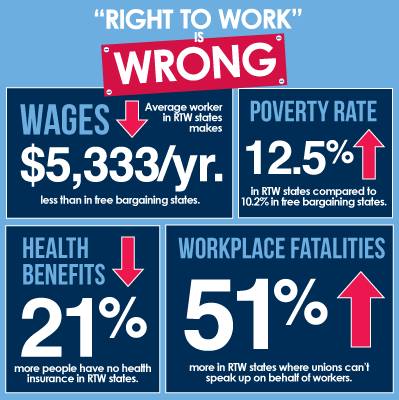
http://www.wrongforeveryone.com/more-facts-on-right-to-work/
The "Urbee" 3D-Printed Car: Coast to Coast on 10 Gallons?
The digital age seems synonymous with change. When it comes to communicating, who doesn't know what an email or a cell phone is, or hasn't heard of Facebook and Twitter?
"In the 21st century, the revolution may not be televised - but it likely will be tweeted, blogged, texted and organized" with digital tools, writes Catherine O'Donnell at the University of Washington.
What is required is a "complete rethink of the automobile," whereby the fundamentals are derived from "a science-based solution to personal mobility that allows movement without damage for centuries to come."
In her article, O'Donnell extensively cites a scholarly report by Phillip Howard, an associate professor in communication at the University of Washington, who was the project lead for a 2011 study quantifying the "use of social media in Arab Spring," Regarding Howard's findings, O'Donnell says the impact of social media in Tunisia and Egypt was nothing short of tremendous, where in the weeks just before Egyptian president Hosni Mubarak was forced to resign "the total rate of tweets from Egypt - and around the world - about political change" exponentially grew from "2,300 a day to 230,000 a day."
http://truth-out.org/news/item/27430-the-urbee-3d-printed-car-coast-to-coast-on-10-gallons
http://metamorphosis.democraticunderground.com/10025562443
Profile Information
Member since: Sun Jul 31, 2011, 05:36 PMNumber of posts: 5,016
